
Aquablation® Therapy for BPH
Benign prostatic hyperplasia (BPH) can make everyday life feel restricted. Frequent trips to the bathroom throughout the day and night can interrupt sleep, limit activities and keep men constantly worrying about where the nearest restroom is.
Aquablation® therapy is a minimally invasive treatment option for men with BPH. By using advanced, precision technology, many men experience lasting symptom relief with minimal risk of long-term complications.
Aquablation Specialists
Aquablation Therapy
What is Aquablation?
Aquablation therapy is a safe and effective treatment for patients suffering from lower urinary tract symptoms (LUTS) due to BPH. It can be performed on prostates of any size and shape. During the procedure, the prostate tissue causing symptoms is removed. Your surgeon accesses the prostate gland through the urethra, so no surgical incision is needed. The treatment uses imaging, robotics and a heat-free waterjet to provide relief with low rates of complications.
Why men choose Aquablation
Aquablation offers several key advantages over traditional BPH treatments.
- Urinary control: Aquablation targets prostate tissue without damaging the bladder, allowing men to urinate naturally.
- Ejaculatory function: Unlike some BPH procedures, Aquablation helps men be able to ejaculate and maintain sexual function.
- Erectile function: Aquablation uses water instead of heat. This difference protects structures important for an erection.
- Urine flow and emptying: Many men report stronger streams, less straining and a reduced feeling of incomplete emptying.
- Long‑lasting symptom relief: Most men experience sustained relief from bothersome BPH symptoms.
Is Aquablation right for you?
Choosing a treatment option can be overwhelming. We work closely with each patient to develop a treatment plan that can include medical and minimally invasive surgical approaches. Contact your primary care physician or call to schedule a consultation with an Aquablation specialist.
Life with BPH
What is BPH?
Benign Prostatic Hyperplasia (BPH), or an enlarged prostate, is a prostate that has grown to be larger than normal. BPH is not prostate cancer.
A normal prostate is approximately the size of a walnut and sits underneath the bladder, wrapped around the urethra. The prostate is a gland that plays an important role in sexual function.
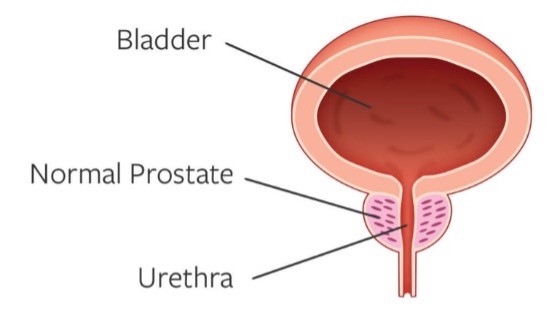
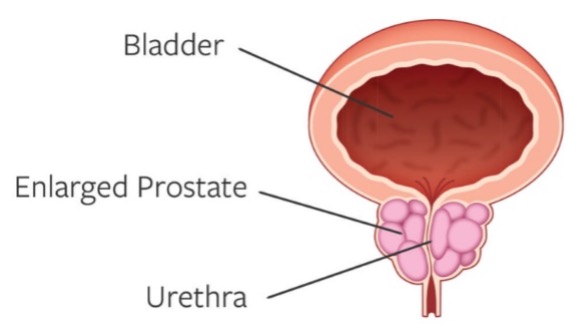
As the prostate enlarges, it may:
- Constrict the urethra, making it difficult to urinate
- Press on the bladder, causing weakening and difficulty emptying
If left untreated, BPH can cause significant health problems, including irreversible bladder or kidney damage, bladder stones and incontinence.
Do you have signs of BPH?
BPH may cause lower urinary tract symptoms (LUTS), which affect the bladder, prostate and urethra. These symptoms impact your ability to hold urine and empty your bladder.
Two LUTS categories
Category 1: Ability to hold urine
- Frequency – the need to urinate more often than normal
- Incontinence – complete loss of the ability to hold urine
- Nocturia – the need to urinate frequently at night while sleeping
- Urgency – the need to urinate immediately or urgently
Category 2: Emptying the bladder
- Dysuria – pain or stinging when urinating
- Hesitancy – difficulty starting to urinate
- Intermittency – a urine stream that starts and stops
- Retention – complete loss of the ability to empty your bladder
- Straining – the need to push or strain to start and complete urinating
- Weak Stream – gentle or weak stream instead of a strong stream of urine